
Views: 222 Author: Rebecca Publish Time: 2025-11-10 Origin: Site


Content Menu
● What Is an Automatic Feeder System?
● Core Components of an Automatic Feeder System
>> 3. Sensing and Detection Devices
>> 5. Frame and Support Structure
>> 6. Material Handling Accessories
● Advanced Technologies and Industry Trends
>> Flexibility for Smart Factories
● Types of Automatic Feeder Systems in Kitchenware Manufacturing
>> Conveyor and Linear Feeders
>> Robotic Pick-and-Place Feeders
● How Automatic Feeder Systems Work: Step by Step
● Selecting and Integrating a Feeder System: Key Considerations
● Implementing an Automatic Feeder System: Practical Tips
>> Site Assessment and Layout Planning
>> Customization and Supplier Collaboration
>> Training and Change Management
● Maintenance, Troubleshooting, and Lifecycle Management
● The Digital Future of Feeder Systems
● Best Practices for Maximizing ROI
● Case Example: Pot Lid Production with Zig Zag Servo Feeder
>> 1. What is the best feeder type for bulk metal utensil production?
>> 2. Can one feeder handle several different product shapes and sizes?
>> 3. How do automatic feeders boost product quality?
>> 4. Are these systems suitable for small or custom kitchenware manufacturers?
>> 5. What ongoing upkeep do feeder systems require?
In the relentless world of modern kitchenware manufacturing, factories must balance speed, precision, and flexibility to remain competitive. Automation stands as the foundation of this transformation, and at its heart lies the automatic feeder system—a central technology for seamlessly supplying parts and materials to downstream machines. For manufacturers of utensils, cookware, and related equipment, a deep understanding of feeder system components, their operation, and integration unlocks significant productivity, quality, and cost advantages.
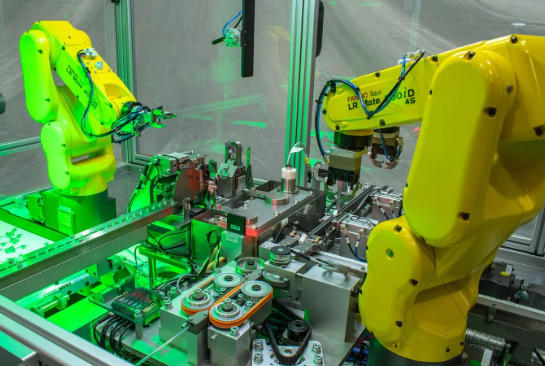
An automatic feeder system is a highly engineered assembly that automates the delivery of raw materials or semi-finished kitchenware parts to a series of processing, forming, or assembly machines. This electromechanical system eliminates the need for manual loading, reducing human error, ensuring efficiency, optimizing flow, and substantially improving consistency in production. In kitchenware manufacturing, feeder systems manage tasks ranging from feeding metal blanks for stamping pot lids to accurately positioning cutlery or small parts for automated assembly.
A high-performing automatic feeder system blends several critical modules, each dedicated to specific duties that collectively ensure smooth, high-speed, and precise operation:
- Vibratory Bowls: The backbone for orienting and supplying small, irregularly shaped parts such as cutlery, screws, or small accessories, using controlled vibrations to move and position parts along spiraling tracks.
- Conveyor Belts and Linear Feeders: These are essential for continuous bulk feeding of trays, utensils, and larger components, providing modular scalability.
- Robotic Pickers: Programmable robotic arms or delta robots handle complex feeding, ideal for randomly oriented or fragile kitchenware requiring careful handling.
- Servo Motors: Highly accurate and programmable, controlling both speed and position, allowing for dynamic adjustment to part flow rates and cycles.
- Pneumatic/Electric Actuators: Provide reliable, repeatable force or motion to push, pull, or lift components to the next station.
- Belt Drives and Gearboxes: Ensure smooth and synchronized movement of bulk items, allowing precise integration with line speeds.
- Photoelectric and Proximity Sensors: Monitor part presence, orientation, and flow, identifying misfeeds and controlling system pauses or corrections.
- Level Sensors: Track bulk supply in hoppers or feed trays, triggering replenishment as required.
- Smart Cameras/Machine Vision: Advanced systems use cameras for orientation validation and automatic rejection of defective parts.
- Programmable Logic Controller (PLC): The “brain” that manages all logic, timing, and error responses, interacting with production line controls.
- Human-Machine Interface (HMI): User-friendly touch panels or terminals allowing operators to adjust feeding parameters, change programs, or run diagnostics with real-time data displays.
- Rigid construction maintains alignment, vibration dampening, and safe integration with presses, molders, or assembly lines. Modular mounting brackets simplify retrofitting and rapid retooling efforts.
- Hoppers: Gravity-fed or vibratory hoppers regulate entry of bulk materials, maintaining a steady supply with minimal jams or gaps.
- Escapements and Chutes: Precisely guide oriented parts to output points, buffering parts for high-speed transfer.
- Elevators and Batch Droppers: Facilitate vertical or multi-level feeding for compact or stacked production lines.
Modern feeder systems often incorporate advanced cameras and image-recognition AI. This allows for:
- Real-time inspection and validation of part orientation/quality.
- Automatically rejecting defective, malformed, or doubled parts, ensuring only perfect kitchenware parts progress.
- Seamless adaptation to product variants without physical retooling, accelerating changeovers.
Many feeder systems are now “smart,” connecting to factory networks for:
- Predictive maintenance notifications, reducing unplanned downtime.
- Centralized data logging for traceability and process optimization.
- Remote troubleshooting, software updates, and diagnostics.
Smart feeders are programmable for multiple product types, supporting quick change between cutlery styles, cookware variants, or custom orders. This is achieved by:
- Swappable tooling and track inserts in vibratory or centrifugal feeders.
- Software-based adjustments to feeding parameters.
- Machine learning algorithms optimizing cycle times automatically.
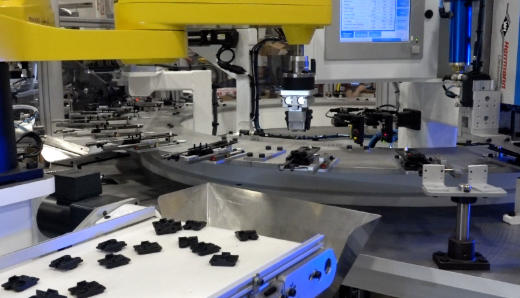
Vibratory bowl feeders remain the industry standard for orienting and feeding smaller, uniquely shaped metal and plastic components. They provide:
- Excellent repeatability and minimal misfeeds.
- Scalability from low to extremely high production runs.
- Integration with downstream vision or robotic picking modules.
Ideal for processes that require continuous, gentle transfer of large, flat, or delicate items—such as baking trays, pot lids, and large utensils—without risk of scratching or deformation.
Designed for round or cylindrical kitchenware items, such as knobs, lids, or handle bases. They utilize a spinning disc for rapid orientation and delivery, providing unmatched throughput for compatible part geometries.
The rise of collaborative robots (cobots) has enabled handling of highly customized or sensitive items. These feeders:
- Support random part orientation and batch sizes.
- Maximize flexibility for smaller, short-run, or mixed-product lines.
- Reduce tooling downtime, allowing for rapid changeovers.
Popular in stamping lines for pot lids or cutlery blanks, zig zag servo feeders use programmable motors to shift sheet metal alternately, achieving nearly “zero-gap” nesting. This means less raw material is required for the same output, driving both cost and waste reduction.
1. Bulk Loading: Large quantities of raw parts are poured into hoppers, designed to buffer and regulate flow.
2. Material Regulation: Advanced sensors signal drives when more material is needed, keeping flow continuous and eliminating jams.
3. Alignment and Separation: Vibratory, conveyor, or robotic mechanisms orient and space the components for downstream operations.
4. Precision Feeding: With sensors tracking every part's journey, components are precisely positioned for the next station, whether that's a stamping, pressing, or assembly point.
5. Integration with Production Line: Automatic feeders sync with existing line speeds and cycles, handing off work seamlessly to maintain continuous operation.
6. Quality Control: Embedded cameras and sensors allow for immediate rejection of misaligned or defective parts.
7. Output Handover: Oriented and quality-checked components are delivered via escapements or guided tracks to the next production or packaging stage.
- Product Geometry and Material: Choose feeders matched to the shapes, weights, and surface finishes of different kitchenware (from delicate glass lids to robust steel trays).
- Volume and Scalability: Systems must support anticipated peak production rates and allow for easy expansion.
- Changeover Efficiency: Modern systems can be reconfigured in minutes for different parts, enabling mixed or rapid-shift production.
- Compatibility: Seamless integration with presses, assembly robots, or packaging solutions is essential.
- Software Capabilities: Prioritize feeders offering user-friendly programming, real-time monitoring, and predictive maintenance analytics.
- Space Efficiency and Noise Levels: Especially important for retrofits or smaller facilities.
- Map out current bottlenecks in your production process.
- Assess the available floor space and how the feeder will interact with upstream and downstream operations.
- Consider staff movement and safety zones around automated equipment.
- Work closely with the feeder system manufacturer to specify tooling requirements, part orientation needs, material compatibility, and output rates.
- Request simulations or prototypes for high-value applications or tricky parts.
- Provide thorough training for operators and maintenance teams, focusing on both daily operations and rapid troubleshooting.
- Emphasize the importance of keeping parts and surfaces clean and free of oil, dust, or debris that could affect feeding performance.
- Schedule regular inspections of mechanical parts, belts, motors, and sensors.
- Lubricate as specified and replace worn drive belts or vibratory elements promptly.
- Utilize the feeder's built-in logging functions to track mean time between failures, downtime causes, and trends in misfeeds.
- Employ analytics to optimize feeder settings, improving both output and reliability.
- Stock critical spares for wear components, sensors, and drive motors.
- Build robust relationships with feeder vendors for fast support, replacement parts, and remote diagnostics if available.
Innovations such as machine learning, cloud integration, and real-time diagnostics are making automatic feeder systems ever smarter and more adaptable. The most advanced feeders in the kitchenware sector can:
- Automatically adapt to different product sizes or batches using machine vision and sensor input.
- Communicate directly with ERP and MES systems for complete line synchronization.
- Enable remote performance optimization and software upgrades.
This digital push further enhances overall equipment efficiency, shop floor transparency, and future-proofing for smart factories.
- Start with a phased integration: pilot feeder systems on the most labor-intensive lines.
- Track metrics before and after feeder installation—productivity, scrap rates, labor hours, downtime.
- Solicit operator feedback on new systems, using their practical experience to identify fine-tuning opportunities.
- Establish clear maintenance routines and invest in periodic specialist training.
Pot lid manufacturing demands both high precision and resource minimization. By using zig zag servo feeders, one major kitchenware plant achieved over 95% material utilization (compared to <85% previously), with output rising from 400 to 600 blanks per hour. Operators also reported fewer jams and less physical strain, supporting both efficiency and workplace safety.
Automatic feeder systems are now indispensable for kitchenware manufacturers striving for operational excellence. By understanding key system components, leveraging advanced automation, and integrating thoughtfully into production lines, kitchenware factories can maximize throughput, minimize errors, enhance quality, and adapt swiftly to market demands. Intelligent feeders are not just about productivity—they also deliver safety, agility, and the information-driven foundation for future factory evolution.

For bulk production of metal utensils, vibratory bowl feeders offer superior efficiency and reliability. They can easily orient a wide range of small parts and are cost-effective for both high and medium-volume lines.
Yes, modern feeders, especially robotic pick-and-place types or those with modular tooling, can adapt to multiple products. Quick-change components and programmable control enable rapid transitions with minimal downtime.
They eliminate manual handling variations, ensure parts are always correctly oriented, and integrate with quality-check sensors or vision systems to reject defects before assembly or packaging.
Absolutely. Flexible feeder systems allow even smaller shops to automate critical processes or diversify product lines without incurring massive labor costs.
Preventive maintenance—regular checks, cleaning, software updates, and swift replacement of wear parts—is essential. A partnership with your system supplier ensures long-term performance and access to upgrades.


